<?xml version="1.0" encoding="UTF-8"?>
<?xml-stylesheet type="text/xsl" href="/stylesheets/feed.atom.xml" media="screen"?>
<feed xml:lang="en-US" xmlns="http://www.w3.org/2005/Atom">
  <id>tag:carelab.nd.edu,2005:/news</id>
  <link rel="alternate" type="text/html" href="https://carelab.nd.edu"/>
  <link rel="self" type="application/atom+xml" href="https://carelab.nd.edu/news.atom"/>
  <id>tag:carelab.nd.edu,2005:/latest</id>
  <title>Childhood and Adolescence Resilience (CARE) Lab | News</title>
  <updated>2026-05-15T11:00:00-04:00</updated>
  <link rel="alternate" type="text/html" href="https://carelab.nd.edu/"/>
  <link rel="self" type="application/atom+xml" href="https://carelab.nd.edu//news.atom"/>
  <subtitle>CARE lab researchers examine how genetic factors and environmental influences impact children’s social, emotional, and academic development over time.</subtitle>
  <entry>
    <id>tag:carelab.nd.edu,2005:News/183111</id>
    <published>2026-05-15T11:00:00-04:00</published>
    <updated>2026-07-17T16:18:27-04:00</updated>
    <link rel="alternate" type="text/html" href="https://carelab.nd.edu/news/end-of-year-celebration-2026/"/>
    <title>End of Year Party 2026</title>
    <summary type="text">
      <![CDATA[The CARE Lab wrapped up another successful year with our annual end-of-year party! It was a chance for everyone to relax, enjoy good food, and spend time together before the semester came to a close. Members also had the opportunity to get creative and make some art to hang up in the lab. Check…]]>
    </summary>
    <content type="html">
      <![CDATA[<p>The CARE Lab wrapped up another successful year with our annual end-of-year party! It was a chance for everyone to relax, enjoy good food, and spend time together before the semester came to a close. Members also had the opportunity to get creative and make some art to hang up in the lab.</p>
<p>Check out the photos below to see our team and their paintings!</p>
<figure class="image image-left"><img src="https://carelab.nd.edu/assets/666496/fullsize/spring2026_final_1_.jpg" alt="Spring 2026 Group Photo" width="2750" height="1833"></figure>
<figure class="image image-left"><img src="https://carelab.nd.edu/assets/666490/paintings.jpg" alt="Paintings Spring 2026" width="600" height="864"></figure>]]>
    </content>
    <link rel="enclosure" type="image/jpeg" href="https://carelab.nd.edu/assets/666496/spring2026_final_1_.jpg" title="Spring 2026 Group Photo"/>
    <author>
      <name>CARE Lab</name>
    </author>
  </entry>
  <entry>
    <id>tag:carelab.nd.edu,2005:News/178130</id>
    <published>2025-12-19T12:00:00-05:00</published>
    <updated>2025-12-19T12:43:24-05:00</updated>
    <link rel="alternate" type="text/html" href="https://carelab.nd.edu/news/happy-holidays/"/>
    <title>Happy Holidays</title>
    <summary type="text">
      <![CDATA[]]>
    </summary>
    <content type="html">
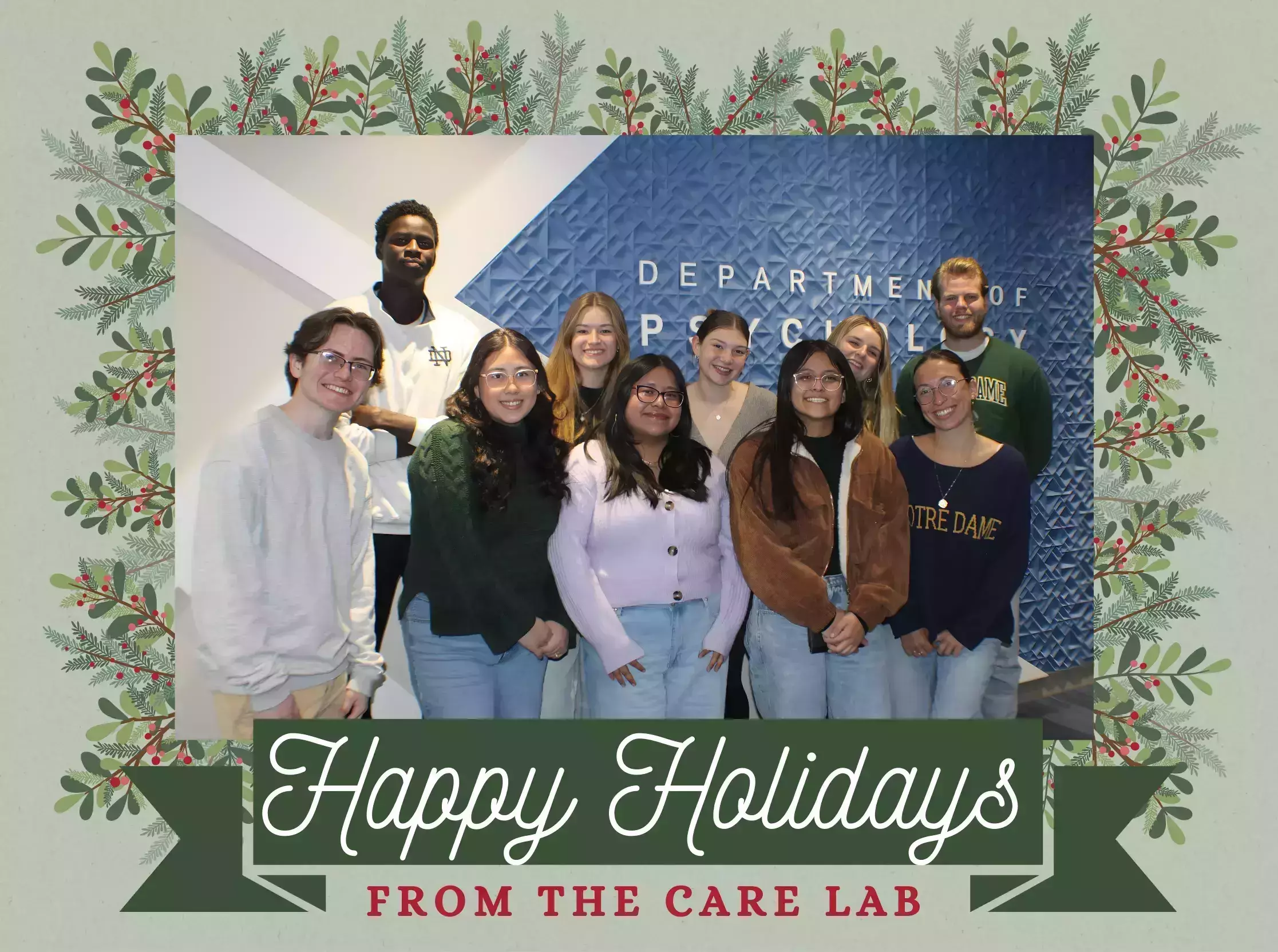
      <![CDATA[<p><img src="https://carelab.nd.edu/assets/643211/fullsize/lab_holiday_2025.webp" alt="" width="1489" height="1109"></p>]]>
    </content>
    <link rel="enclosure" type="image/webp" href="https://carelab.nd.edu/assets/643211/lab_holiday_2025.webp" title="Lab holiday Photo 2025"/>
    <author>
      <name>CARE Lab</name>
    </author>
  </entry>
  <entry>
    <id>tag:carelab.nd.edu,2005:News/176723</id>
    <published>2025-11-07T08:00:00-05:00</published>
    <updated>2025-11-20T15:06:30-05:00</updated>
    <link rel="alternate" type="text/html" href="https://carelab.nd.edu/news/jenifer-guadalupe-solano-becerra-awarded-2024-research-for-the-common-good-award/"/>
    <title>Jenifer Guadalupe Solano Becerra Awarded 2024 Research for the Common Good Award</title>
    <summary type="text">
      <![CDATA[CARE Lab member Jenifer Guadalupe Solano Becerra has been awarded the 2024 Research for the Common Good Award through the Institute for Social Concerns for her work…]]>
    </summary>
    <content type="html">
      <![CDATA[<figure class="image image-right"><img src="https://carelab.nd.edu/assets/639376/jenifer_award.jpeg" alt="Jenifer Award" width="600" height="713"></figure>
<p>CARE Lab member Jenifer Guadalupe Solano Becerra has been awarded the 2024 Research for the Common Good Award through the Institute for Social Concerns for her work addressing the needs of marginalized and immigrant communities. With her award grant funding, Jenifer conducted research that explored how trauma-responsive, bilingual social work interventions impact socioemotional resilience and family stability in immigrant households.</p>
<p>Her interviews with social workers across Nebraska and direct work with Spanish-speaking families highlights the power of culturally attuned, trust-based care in promoting community well-being. Beyond research, Jenifer designed and led an eight-week Spanish-language summer learning program for newly arrived immigrant students to meet the needs of immigrant families in the Lincoln community and foster confidence and connection.</p>
<p>We are incredibly proud of Jenifer and her dedication to research and community engagement!</p>
<p><strong id="docs-internal-guid-30e9bc6a-7fff-e756-3e92-0775343f2f7e">Read her full story here: <a href="https://socialconcerns.nd.edu/news/researching-for-the-common-good-jenifer-solano/">Researching for the Common Good: Jenifer Guadalupe Solano Becerra</a> </strong></p>]]>
    </content>
    <link rel="enclosure" type="image/jpeg" href="https://carelab.nd.edu/assets/639378/jenifer_award_preview.jpeg" title="Jenifer Award-News Heading"/>
    <author>
      <name>CARE Lab</name>
    </author>
  </entry>
  <entry>
    <id>tag:carelab.nd.edu,2005:News/176722</id>
    <published>2025-10-24T08:00:00-04:00</published>
    <updated>2025-11-20T14:59:23-05:00</updated>
    <link rel="alternate" type="text/html" href="https://carelab.nd.edu/news/strong-roots-study-announcement/"/>
    <title>Strong Roots Study Announcement</title>
    <summary type="text">
      <![CDATA[The CARE Lab is excited to announce the launch of the Strong Roots Study! This project explores what helps parents and children thrive. The project aims to learn more about how individual factors, like well-being and personality, along with family relationships and neighborhood contexts, work…]]>
    </summary>
    <content type="html">
      <![CDATA[<p>The CARE Lab is excited to announce the launch of the Strong Roots Study!</p>
<p>This project explores what helps parents and children thrive. The project aims to learn more about how individual factors, like well-being and personality, along with family relationships and neighborhood contexts, work together to shape resilience in families. By studying parents and children together, we hope to uncover what really supports family growth and well-being.We are excited to begin this important work!</p>
<p> </p>]]>
    </content>
    <link rel="enclosure" type="image/webp" href="https://carelab.nd.edu/assets/635208/sr_flyer_what_makes_your_family_strong_2_.webp" title="Strong Roots Flyer"/>
    <author>
      <name>Logan Rios</name>
    </author>
  </entry>
  <entry>
    <id>tag:carelab.nd.edu,2005:News/176721</id>
    <published>2025-09-05T08:00:00-04:00</published>
    <updated>2025-11-20T14:58:04-05:00</updated>
    <link rel="alternate" type="text/html" href="https://carelab.nd.edu/news/summer-intern-spotlight-herjok-panther-deng-agot/"/>
    <title>Summer Intern Spotlight: Herjok Panther Deng Agot</title>
    <summary type="text">
      <![CDATA[This summer, Herjok Panther Deng Agot assisted the CARE Lab with research exploring how neighborhood environments shape family resilience. Throughout the summer, Panther was trained on LAND (Lot Level Assessment of Neighborhood Disorder) coding, which involves evaluating neighborhood conditions…]]>
    </summary>
    <content type="html">
      <![CDATA[<p>This summer, Herjok Panther Deng Agot assisted the CARE Lab with research exploring how neighborhood environments shape family resilience.</p>
<p>Throughout the summer, Panther was trained on LAND (Lot Level Assessment of Neighborhood Disorder) coding, which involves evaluating neighborhood conditions such as upkeep, litter, and graffiti using Google Street View. Panther presented his work at the Galvin Scholars Poster Session, where he shared what he learned about research, coding, and neighborhoods. Through this experience, he strengthened his research skills, attention to detail, and deepened his interest in how communities support resilience.</p>
<p>We loved having Panther in the lab this summer. Panther’s enthusiasm and positive attitude made this summer in the lab a joy, and we’re excited to keep working with him!</p>
<p> </p>]]>
    </content>
    <link rel="enclosure" type="image/jpeg" href="https://carelab.nd.edu/assets/639373/panther_poster_final.jpg" title="Panther Poster"/>
    <author>
      <name>CARE Lab</name>
    </author>
  </entry>
  <entry>
    <id>tag:carelab.nd.edu,2005:News/174915</id>
    <published>2025-08-04T08:00:00-04:00</published>
    <updated>2025-09-23T15:45:38-04:00</updated>
    <link rel="alternate" type="text/html" href="https://carelab.nd.edu/news/summer-intern-spotlight-amaria-clark/"/>
    <title>Summer Intern Spotlight: Amaria Clark</title>
    <summary type="text">
      <![CDATA[This summer, Amaria Clark joined the CARE Lab through the Summer Research Opportunities Program (SROP) at the University of Notre Dame, which gives students opportunities…]]>
    </summary>
    <content type="html">
      <![CDATA[<figure class="image image-right"><img src="https://carelab.nd.edu/assets/631404/amaria_poster_1_.jpg" alt="Amaria poster" width="600" height="524"></figure>
<p>This summer, Amaria Clark joined the CARE Lab through the Summer Research Opportunities Program (SROP) at the University of Notre Dame, which gives students opportunities to gain mentored research experience.</p>
<p>During her time with the lab, Amaria coducted virtual audits of neighborhood disorder and completed her own research project examining the moderating role of quality sibling relationships between neighborhood deprivation and externalizing behaviors in youth. Amaria presented her poster "Quality Sibling Relationships: A Protective Factor for Externalizing Behaviors in Children Exposed to Neighborhood Deprivation" at the Summer Research Poster Session.</p>
<p>Amaria will be returning to Howard University this fall to start her Ph.D. in Clinical Psychology. We are excited to see what she accomplishes and wish her the best!</p>]]>
    </content>
    <link rel="enclosure" type="image/jpeg" href="https://carelab.nd.edu/assets/631404/amaria_poster_1_.jpg" title="Amaria poster"/>
    <author>
      <name>CARE Lab</name>
    </author>
  </entry>
  <entry>
    <id>tag:carelab.nd.edu,2005:News/173794</id>
    <published>2025-06-02T16:53:00-04:00</published>
    <updated>2025-07-25T16:53:27-04:00</updated>
    <link rel="alternate" type="text/html" href="https://carelab.nd.edu/news/dr-shewark-at-srcd-2025/"/>
    <title>Dr. Shewark at SRCD 2025</title>
    <summary type="text">
      <![CDATA[This spring, Dr. Shewark and Logan attended the 2025 Biennial Meeting of the Society for Research in Child Development. Dr. Shewark presented her poster entitled Continuity and Discontinuity in the Etiology of Youth Resilience Development from Middle Childhood Through Adolescence. Her research…]]>
    </summary>
    <content type="html">
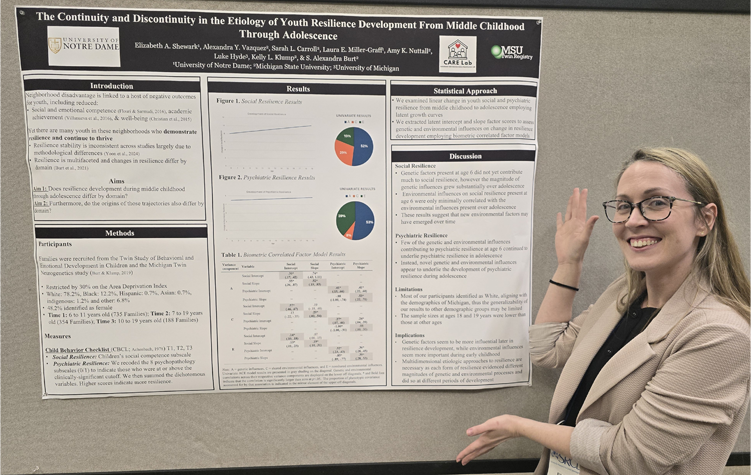
      <![CDATA[<p>This spring, Dr. Shewark and Logan attended the 2025 Biennial Meeting of the Society for Research in Child Development. Dr. Shewark presented her poster entitled <em>Continuity and Discontinuity in the Etiology of Youth Resilience Development from Middle Childhood Through Adolescence</em>. Her research examined how youths' social and psychiatric resilience to under-resourced neighborhoods changes over the course of middle childhood and adolescence. The results showed that social and psychiatric resilience tend to increase over time, and that the genetic and environmental factors influencing resilience differ depending on the type of resilience being considered.   <img src="https://carelab.nd.edu/assets/622302/original/shewark_poster1.png" alt="" width="752" height="475"></p>
<p> </p>]]>
    </content>
    <link rel="enclosure" type="image/png" href="https://carelab.nd.edu/assets/622302/shewark_poster1.png" title="Shewark SRCD 2025"/>
    <author>
      <name>CARE Lab</name>
    </author>
  </entry>
  <entry>
    <id>tag:carelab.nd.edu,2005:News/173785</id>
    <published>2025-05-12T10:00:00-04:00</published>
    <updated>2025-07-14T14:02:17-04:00</updated>
    <link rel="alternate" type="text/html" href="https://carelab.nd.edu/news/end-of-the-semester-party/"/>
    <title>CARE Lab Celebrates the End of Spring 2025 Semester</title>
    <summary type="text">
      <![CDATA[To celebrate the end of a busy semester and all of our students' hard work, members of the CARE lab got together for a Pizza Painting…]]>
    </summary>
    <content type="html">
      <![CDATA[<figure class="image image-right"><img src="https://carelab.nd.edu/assets/622267/953x650/pizzapaintingparty_group_5_.jpg" alt="Party SP25 Group Photo" width="600" height="409"></figure>
<p>To celebrate the end of a busy semester and all of our students' hard work, members of the CARE lab got together for a Pizza Painting Party! Held outside on a beautiful day, the event gave everyone a chance to unwind with good food, creativity, and great company.</p>
<p> </p>
<p>Check out the photo to see everyone's beautiful art!</p>]]>
    </content>
    <link rel="enclosure" type="image/jpeg" href="https://carelab.nd.edu/assets/622268/pizzapaintingparty_group_4_.jpg" title="Party Feature Photo"/>
    <author>
      <name>CARE Lab</name>
    </author>
  </entry>
  <entry>
    <id>tag:carelab.nd.edu,2005:News/171480</id>
    <published>2025-04-08T10:10:00-04:00</published>
    <updated>2026-02-25T17:26:00-05:00</updated>
    <link rel="alternate" type="text/html" href="https://carelab.nd.edu/news/new-publication-in-developmental-psychology/"/>
    <title>New Publication in Developmental Psychology</title>
    <summary type="text">
      <![CDATA[We are excited to share Dr. Shewark and Colleagues' newest publication "Both Stressor and Assets Moderated the Etiology of Mothers' Parenting During the Pandemic" in Developmental Psychology. The study examined whether pandemic-related experiences impacted the genetic and environmental influences…]]>
    </summary>
    <content type="html">
      <![CDATA[<p>We are excited to share Dr. Shewark and Colleagues' newest publication "Both Stressor and Assets Moderated the Etiology of Mothers' Parenting During the Pandemic" in <em>Developmental Psychology</em>. The study examined whether pandemic-related experiences impacted the genetic and environmental influences on maternal parenting. Findings showed that as pandemic-related stressors increased, environmental influences on mother-child conflict increased. By contrast, positive pandemic experiences bolstered maternal nurturance by reducing child-driven effects on nurturance. These results help us better understand the pathways by which stress impacts parenting. </p>
<p>To learn more, check out the full article <a href="https://psycnet.apa.org/record/2025-82263-001?doi=1">here</a>!</p>]]>
    </content>
    <author>
      <name>CARE Lab</name>
    </author>
  </entry>
  <entry>
    <id>tag:carelab.nd.edu,2005:News/169408</id>
    <published>2025-01-22T09:00:00-05:00</published>
    <updated>2025-01-23T21:26:08-05:00</updated>
    <link rel="alternate" type="text/html" href="https://carelab.nd.edu/news/care-lab-opens/"/>
    <title>Introducing the CARE Lab</title>
    <summary type="text">
      <![CDATA[The CARE Lab officially opened in Fall 2024 within the Department of Psychology at the University of Notre Dame. Under the direction of Dr. Elizabeth Shewark, the lab will explore how individual characteristics, environments, and genetics shape youth resilience development. Overall, the CARE Lab's…]]>
    </summary>
    <content type="html">
      <![CDATA[<p>The CARE Lab officially opened in Fall 2024 within the Department of Psychology at the University of Notre Dame. Under the direction of Dr. Elizabeth Shewark, the lab will explore how individual characteristics, environments, and genetics shape youth resilience development. Overall, the CARE Lab's research aims to better understand how genetic and environmental (e.g., family, neighborhood, and school environments) factors shape children’s resilience development (e.g., social, emotional, and academic competence). The lab’s current work explores how different features of the neighborhood shape the development of youth resilience in hopes to identify features that can promote resilience.</p>
<p>Last semester, Dr. Shewark and members of the CARE lab spent time recruiting a team of undergraduate research assistants, writing many protocols, and setting up the lab space. This semester, the CARE Lab plans to start our virtual neighborhood audits and prepare to start collecting data in the fall.</p>
<p>We are excited about the future of the CARE Lab and look forward to the work ahead!</p>
<p> </p>]]>
    </content>
    <link rel="enclosure" type="image/png" href="https://carelab.nd.edu/assets/598046/care_lab_10_500_x_475_px_3_.png" title="CARE Lab Logo Red Heart"/>
    <author>
      <name>Logan Rios</name>
    </author>
  </entry>
  <entry>
    <id>tag:carelab.nd.edu,2005:News/169409</id>
    <published>2025-01-22T09:00:00-05:00</published>
    <updated>2025-01-27T07:49:39-05:00</updated>
    <link rel="alternate" type="text/html" href="https://carelab.nd.edu/news/dr-shewark-receives-grant-to-investigate-neighborhoods-and-resilience/"/>
    <title>Dr. Elizabeth Shewark receives grant to investigate neighborhoods and youth resilience</title>
    <summary type="text">
      <![CDATA[Dr. Elizabeth Shewark was awarded an NIH R00 Pathway to Independence Award entitled, "The Development of Youth Resilience to Neighborhood Disadvantage". This three-year grant will support Dr. Shewark’s research into how various neighborhood features may promote the development of resilience…]]>
    </summary>
    <content type="html">
      <![CDATA[<p>Dr. Elizabeth Shewark was awarded an NIH R00 Pathway to Independence Award entitled,<em> "The Development of Youth Resilience to Neighborhood Disadvantage"</em>. This three-year grant will support Dr. Shewark’s research into how various neighborhood features may promote the development of resilience in youth.</p>
<p>Dr. Shewark and the CARE lab will examine data from the Study of Adolescent to Adult Neurodevelopment (SAND) to assess the neighborhood features of 350 families when the child was ages 9, 15, and 22. We will conduct virtual neighborhood audits using Google Street View to examine signs of physical disorder, such as lot maintenance and vacancies. Additionally, public neighborhood data will be utilized to gather information about additional features within the neighborhood, including bluespace (e.g., lakes), greenspace (e.g., parks), and commercial businesses.</p>
<p>This project has two key goals. First, Dr. Shewark aims to identify protective structural features within neighborhoods, such as parks, libraries, and community centers that may promote youth resilience development. The second is to investigate how these neighborhood features may support resilient parenting practices which, in turn, promote youth resilience.</p>
<p>Through this project, Dr. Shewark hopes to identify protective physical features within the environment that can be targeted to promote resilience and help youth thrive.</p>
<p> </p>]]>
    </content>
    <link rel="enclosure" type="image/jpeg" href="https://carelab.nd.edu/assets/602251/shewark.jpg" title="Photo of Dr. Elizabeth Shewark"/>
    <author>
      <name>Logan Rios</name>
    </author>
  </entry>
  <entry>
    <id>tag:carelab.nd.edu,2005:News/169405</id>
    <published>2025-01-21T16:02:00-05:00</published>
    <updated>2025-01-21T16:02:43-05:00</updated>
    <link rel="alternate" type="text/html" href="https://carelab.nd.edu/news/six-new-faculty-members-join-notre-dame-psychology-department-to-advance-research-on-mental-health-sleep-disorders-substance-use-and-other-issues/"/>
    <title>Six new faculty join psychology department to advance research on mental health, other disorders</title>
    <summary type="text">
      <![CDATA[The Department of Psychology at the University of Notre Dame has hired six new faculty members this year, a significant expansion of a field that is core to the University’s commitment to fighting the U.S. mental health crisis.]]>
    </summary>
    <content type="html">
      <![CDATA[<p>The <a href="https://psychology.nd.edu/">Department of Psychology</a> at the University of Notre Dame has hired six new faculty members this year, a significant expansion of a field that is core to the University’s commitment to fighting the U.S. mental health crisis.</p>
<p>The new assistant professors — Ryan Carpenter, Haya Fatimah, Kaylin Hill, Matthew Robison, Elizabeth Shewark and Ivan Vargas — will further research in their subfields of cognitive, behavioral, clinical and developmental psychology. Their scholarly work will aim to address the psychological causes and effects of various issues such as trauma, self-harm, sleep disorders and substance use disorder.</p>
<p>“The addition of six new faculty members to a single department in one year is a rare and transformative event,” said <a href="https://psychology.nd.edu/people/james-brockmole/">James Brockmole</a>, professor of psychology and chair of the department. “By recruiting these outstanding young scholars to Notre Dame, we have significantly expanded the questions we can ask about a wide range of mental phenomena, the methods that we can use to derive answers to those questions, and the educational opportunities that we can offer to our undergraduate and graduate students.”</p>
<p>Four of the new faculty are clinical psychologists and will conduct research at the new <a href="https://news.nd.edu/news/veldman-family-makes-gift-to-notre-dame-for-a-mental-health-research-and-services-clinic/">Veldman Family Psychology Clinic</a>, which broke ground at 501 N. Hill St. in South Bend’s East Bank neighborhood on Sept. 20 and is expected to be completed in 2026. The 36,000-square-foot facility is the first piece of Notre Dame’s <a href="https://news.nd.edu/news/notre-dame-makes-68-million-commitment-to-fighting-mental-health-crisis-scalable-solutions-could-become-national-model/">$68 million commitment</a> to improving mental health on campus, in the South Bend community and across the nation.</p>
<p>Once at full capacity, the clinic will serve more than 1,500 people in the South Bend community annually through mental health assessment, intervention and prevention services, and will be home to faculty and graduate students developing scalable, evidence-based solutions that address childhood trauma, substance use and other mental health concerns.</p>
<h3><strong>Understanding where substance use disorder begins</strong></h3>
<figure class="image image-left"><img src="https://al.nd.edu/assets/587083/ryan_carpenter_crop_250x.jpg" alt="Ryan Carpenter" width="188" height="250">
<figcaption>Ryan Carpenter</figcaption>
</figure>
<p>In his research, clinical psychologist <a href="https://psychology.nd.edu/people/ryan-carpenter/">Ryan Carpenter</a> focuses on understanding substance use in the everyday lives of everyday people.</p>
<p>To examine alcohol and opioid use, Carpenter uses technologies such as smartphones and portable breathalyzers to understand what occurs in people’s lives that ultimately triggers their decision to imbibe in addictive substances. In his lab, he is also interested in testing if mobile health interventions, such as smartphone apps, can be helpful to people trying to address their substance use.</p>
<p>“To improve treatment options, there is a critical need to better understand why some people can use substances largely without issue, while others develop significant problems,” he said.</p>
<p>Carpenter, who was a postdoctoral fellow at Brown University and most recently was an assistant professor at the University of Missouri-St. Louis, currently has two projects funded by the National Institute on Alcohol Abuse and Alcoholism to develop and tailor behavioral interventions to address the co-use of alcohol and opioids in young adults and to help people who are drinking alcohol while in treatment for opioid use.</p>
<p>At Notre Dame, Carpenter said, he’s looking forward to collaborating with his colleagues and to making lasting relationships with South Bend community partners. He said the development of the Veldman Family Psychology Clinic will also provide critical infrastructure for both conducting substance use research and providing treatment services in the community.</p>
<p>“A major draw of Notre Dame for me is the opportunity to be around so many people studying so many important and interesting research questions,” he said. “It’s energizing and I’m looking forward to building new collaborations here across the department, college and University, as well as the broader Michiana community.”</p>
<h3><strong>Predicting self-harm tendencies</strong></h3>
<figure class="image image-left"><img src="https://al.nd.edu/assets/587086/fatimah_250x.jpg" alt="Haya Fatimah" width="188" height="250">
<figcaption>Haya Fatimah</figcaption>
</figure>
<p>Clinical psychologist <a href="https://psychology.nd.edu/people/faculty/haya-fatimah/">Haya Fatimah</a> studies complex dynamics in psychopathology, especially those with borderline personality and comorbid disorders.</p>
<p>Fatimah received her doctorate from the University of South Florida and completed a postdoctoral clinical internship at McLean Hospital with Harvard Medical School. She is particularly interested in predicting factors and behaviors that are aligned with borderline personality disorder such as suicide, non-suicidal injury and substance use. She is currently studying the complex dynamics underlying nonsuicidal self-injury in youth, with the goal of identifying critical windows of risk to inform prevention and treatment efforts.</p>
<p>Fatimah’s goal at Notre Dame in this research is to develop personalized treatment with a dynamic systems approach to understand personality pathology and focus on risk factors and processes at the level of a single individual.</p>
<p>“I am especially interested in how personality pathology emerges, and what we can do about it,” she said.</p>
<h3><strong>Lifting the burden of depression</strong></h3>
<figure class="image image-left"><a href="https://psychology.nd.edu/people/kaylin-hill/"><img src="https://al.nd.edu/assets/587082/kaylinestell_gmailcom_1_copy_1_250x.jpg" alt="Kaylin Hill" width="188" height="250"></a>
<figcaption>Kaylin Hill</figcaption>
</figure>
<p><a href="https://psychology.nd.edu/people/kaylin-hill/">Kaylin Hill</a> finds that emotional experiences are at the heart of what is important to us.</p>
<p>Originally from the South Bend area, Hill received her doctorate in clinical psychology from Purdue University. She studied psychophysiological assessment in particular, using electroencephalogram as an assessment tool in understanding emotions, as well as other neural processes such as reward and error-monitoring.</p>
<p>“I continued to pursue these questions related to understanding emotions broadly and depression more specifically, and as I began to understand more of what these processes look like in adults, I began to ask more questions about how they developed,” she said.</p>
<p>She continued her analysis during a postdoctoral appointment in developmental psychopathology at Vanderbilt University. Hill’s current research focuses on how to better characterize depression symptoms, refine psychophysiological assessment for individuals, and identify both individual and contextual risk processes with a focus toward intervention.</p>
<p>“As a clinical psychologist, the ultimate aim of my work is to reduce the tremendous burden of depression on individuals and families,” she said.</p>
<p>As part of that, Hill is creating the Psychophysiology of Affect Across the Lifespan (PAL) Lab at Notre Dame, where the aim will be to examine emotion and social processes related to depression and the risk of depression in individuals and families.</p>
<p>“I am excited to work alongside my esteemed colleagues, to teach and mentor such wonderful students, and especially to contribute to the growing neuroscience area and to work with the community through the <a href="https://shaw.nd.edu/">William J. Shaw Center for Children and Families</a>,” Hill said. “Additionally, working on campus means that I get to revisit nostalgic experiences from when I was kid, and I am thrilled to offer the same experiences to my children alongside their grandparents.”</p>
<h3><strong>The challenge of attention retention</strong></h3>
<figure class="image image-left"><img src="https://al.nd.edu/assets/587084/matthew_robison_headshot_square_1_250x.jpg" alt="Matthew Robison" width="188" height="250">
<figcaption>Matthew Robison</figcaption>
</figure>
<p>As a cognitive psychologist, <a href="https://psychology.nd.edu/people/matthew-robison/">Matthew Robison</a> aims to answer questions regarding attentiveness — how are some people able to control and sustain their attention while others struggle? Why do people feel alert in some moments but not in others? How do lifestyle factors like sleep, mood and exercise affect cognitive function?</p>
<p>“Attention seems to be one of the core cognitive skills that leads us to success in a variety of mental endeavors,” Robison said. “However, we also know that controlling and sustaining attention is difficult, particularly for some people, and doing so for a long period of time can produce mental strain and fatigue.”</p>
<p>Through his research, Robison addresses three key points — identifying psychological factors that might cause a person to be inattentive and distracted, recognizing when keeping attention causes stress and fatigue, and answering if a person can improve their attention through training exercises.</p>
<p>Robison received his doctorate from the University of Oregon and was a postdoctoral scholar at Arizona State University and an assistant professor at the University of Texas at Arlington. A Notre Dame alumnus, he said his return as a faculty member was once a distant dream that has now come true.</p>
<p>“I am excited to collaborate with the wonderful faculty we have in the department and all across campus,” he said. “I’m eager to mentor graduate students to be excellent psychological scientists in this vibrant and rigorous academic environment, to teach and train our undergraduate students in psychological science, and to actively participate in the on-campus and greater South Bend community both through my research and in many other ways.”</p>
<h3><strong>Resilience in childhood trauma development</strong></h3>
<figure class="image image-left"><img src="https://al.nd.edu/assets/587085/shewark_cropped_250x.jpg" alt="Elizabeth Shewark" width="188" height="250">
<figcaption>Elizabeth Shewark</figcaption>
</figure>
<p>As an undergraduate, <a href="https://psychology.nd.edu/people/elizabeth-shewark/">Elizabeth Shewark</a> found herself becoming increasingly interested in the motivations behind people’s behavior, taking courses in developmental psychology that covered everything from the prenatal period to aging and death.</p>
<p>“I was hooked,” she said. “Change is life. How lucky are we that we get to change over time — that we get to explore all these different versions of ourselves over the course of our lifespan?”</p>
<p>Now, as a developmental psychologist at Notre Dame, Shewark has set a research goal to examine children’s resilience development within their social systems such as families, schools and neighborhoods. She examines this by applying cutting-edge research and statistical methods to illuminate the biological and environmental impacts on child development.</p>
<p>She has further applied this research interest, with support from a National Institutes of Health Pathway to Independence Award, toward children who face trauma and adversity through poverty and exposure to community violence.</p>
<p>Shewark received her doctorate from Penn State University and was inspired to come to Notre Dame after visiting with psychology faculty member <a href="https://psychology.nd.edu/people/laura-miller-graff/">Laura Miller-Graff</a> and the psychology department, as well as attending the <a href="https://lucyinstitute.nd.edu/">Lucy Family Institute for Data &amp; Society</a>’s Health Equity Data Forum.</p>
<p>“I kept thinking how amazing it would be to work here, with these brilliant individuals and at a university that asks, ‘How can we help?’” she said. “I am incredibly honored to have joined such a thoughtful, innovative and service-oriented community of scholars where I feel like I can have an impact. I look forward to building connections both within the University and in the surrounding communities to advance healthy development for all.”</p>
<h3><strong>Insomnia’s impact on health</strong></h3>
<figure class="image image-left"><img src="https://al.nd.edu/assets/587081/ivan_vargas_headshot_250x.jpg" alt="Ivan Vargas" width="188" height="250">
<figcaption>Ivan Vargas</figcaption>
</figure>
<p>Sleep can occupy a third of one’s life, yet little is known about it. <a href="https://psychology.nd.edu/people/faculty/ivan-vargas/">Ivan Vargas</a>’ research aims to better understand insomnia and its effects on overall health.</p>
<p>“One idea I hope people can take away from the work that I do is that insomnia is not only bad for your sleep, it’s also bad for your health,” he said. “Insomnia affects a lot of people every day, and we often overlook the negative consequences it can have on our overall mental and physical health.”</p>
<p>Vargas received his doctorate in clinical psychology from the University of Michigan and completed a postdoctoral fellowship at the Behavioral Sleep Medicine Program and the Center for Sleep and Circadian Neurobiology at the University of Pennsylvania Perelman School of Medicine. He was most recently an assistant professor at the University of Arkansas.</p>
<p>His work includes a number of projects that evaluate behavioral interventions for sleep such as cognitive behavioral therapy for insomnia. His research is currently supported by a National Institutes of Health career development award funded by the National Heart, Lung, and Blood Institute.</p>
<p>Vargas also received his bachelor’s degree from Notre Dame and said he’s excited to see the University’s increased commitment to identifying solutions to address the mental health crisis.</p>
<p>“I look forward to the opportunities that this will provide to our department,” he said. “My hope is that in my time here at Notre Dame, we can expand the knowledge and resources that are available for people struggling with insomnia and related sleep problems.”</p>
<p class="attribution">Originally published by <span class="rel-author">Mary Kinney</span> at <span class="rel-source"><a href="https://al.nd.edu/news/latest-news/six-new-faculty-members-join-notre-dame-psychology-department-to-advance-research-on-mental-health-sleep-disorders-substance-use-and-other-issues/">al.nd.edu</a></span> on <span class="rel-pubdate">Sept. 25.</span></p>
<p class="attribution"><span class="rel-pubdate"><em><strong>Contact: Tracy DeStazio</strong>, associate director of media relations, 574-631-9958 or <a href="mailto:tdestazi@nd.edu">tdestazi@nd.edu</a></em></span></p>]]>
    </content>
    <link rel="enclosure" type="image/jpeg" href="https://carelab.nd.edu/assets/601540/mc_81022_corbett_4th_floor_011200x.jpg" title="Text describing the Department of Psychology across a texturize blue wall."/>
    <author>
      <name>Mary Kinney</name>
    </author>
  </entry>
</feed>